CHARLOTTE POLICE RACISM SCANDAL: SIX OFFICERS IMPLICATED IN RACIST TEXTS AS QUESTIONS RESURFACE ABOUT BLACK TEEN FOUND HANGING FROM A TREE

730 BOOM RADIO | NATIONAL NEWS, CIVIL RIGHTS & JUSTICE
October 19, 2026
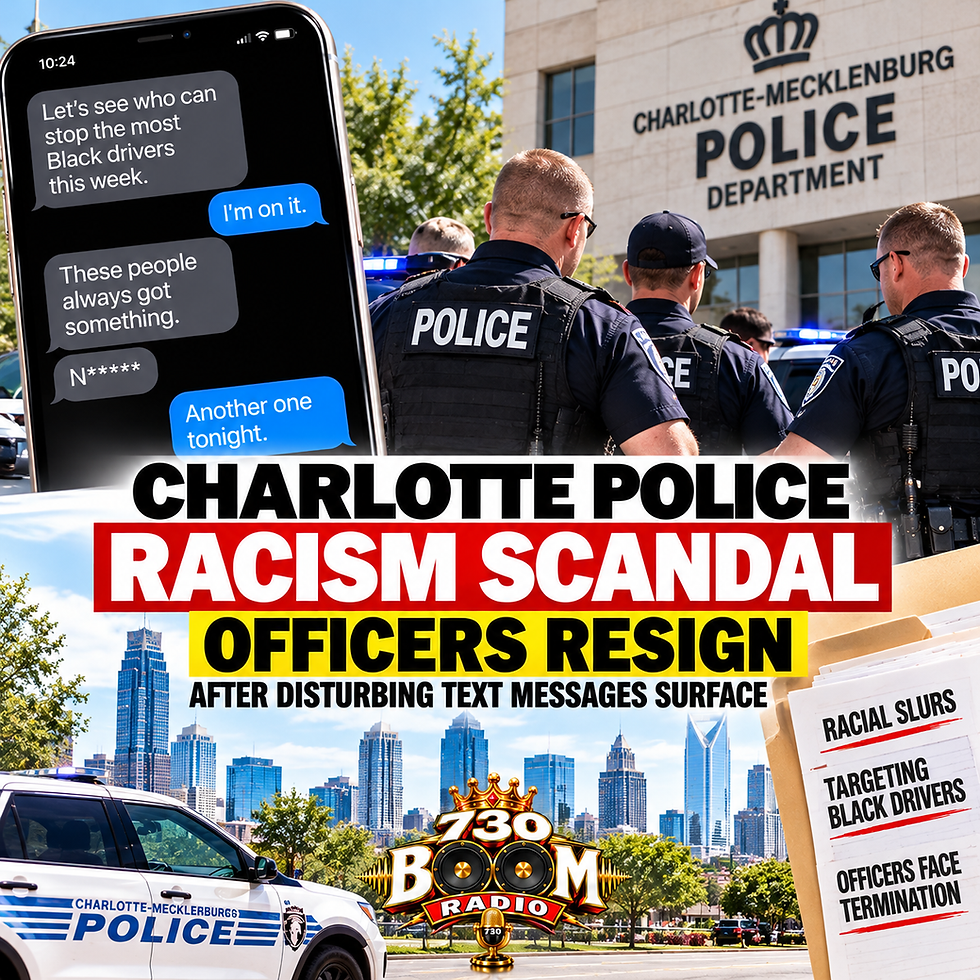
CHARLOTTE, NORTH CAROLINA | The Charlotte-Mecklenburg Police Department is facing serious questions about racism, accountability, and public trust after investigators uncovered text messages allegedly showing officers competing to see who could stop the most Black drivers.
Three officers have resigned, and three others have been recommended for termination following an internal investigation.
But the controversy is also bringing renewed attention to another troubling case involving the same police department: the death of 16-year-old Juliana Umba Nzita, a Black teenager discovered hanging from a tree on church property in Charlotte earlier this year.
While there is no verified evidence connecting the officers involved in the racist text messages to Juliana's investigation, both cases have raised important questions about transparency and public confidence in law enforcement.
OFFICERS ALLEGEDLY COMPETED TO STOP BLACK DRIVERS
According to investigative reporting by Charlotte television station WBTV, sources familiar with the messages alleged that officers participated in a group conversation involving a competition to see who could pull over the most Black motorists.
The messages reportedly included repeated use of the N-word, along with disturbing references to using force and discharging firearms against Black residents.
The allegations were not limited to racism. Police Chief Estella Patterson confirmed that the conversations also demonstrated sexual and religious bias.
The messages reportedly dated back several years.
Four of the six officers involved graduated from the police academy in 2024, according to Patterson.
The department has not publicly released their identities.
THREE OFFICERS RESIGN, THREE MORE FACE TERMINATION
During an October 15 news conference, Chief Patterson confirmed that three officers had resigned and that an internal review board unanimously recommended termination for the remaining three.
Patterson supported those recommendations but explained that Charlotte's Civil Service Board must complete the required process before the remaining officers can be dismissed.
The chief also announced plans to pursue revocation of the officers' North Carolina law enforcement certifications, which could prevent them from serving as officers elsewhere in the state.
Patterson, who is Black, publicly expressed disgust, anger, and frustration over the revelations.
She acknowledged how painful it was to hear allegations of racism involving officers from the same department where she began her law enforcement career.
The chief emphasized that the department must determine whether the alleged conduct reflects a broader problem.
HOW THE RACIST MESSAGES WERE DISCOVERED
The investigation began with an unrelated criminal inquiry involving former Charlotte-Mecklenburg officer Seth Elliott.
The North Carolina State Bureau of Investigation had been examining allegations that Elliott improperly used the Flock Safety automated license plate reader network and other police technology.
During that investigation, authorities recovered information from Elliott's cellphone.
According to WBTV, investigators discovered the offensive group messages and provided the information to Charlotte-Mecklenburg Police, prompting an internal investigation.
Elliott had already resigned and was facing a separate criminal charge involving the alleged misuse of police technology.
WHAT ABOUT THE BLACK DRIVERS THESE OFFICERS STOPPED?
The revelations have raised questions about whether the officers' alleged prejudices affected their professional conduct.
Charlotte-Mecklenburg Police reviewed traffic-stop records, arrests, complaints, and body-camera footage involving the officers.
As of October 15, Patterson said the department had not established that the six officers specifically targeted Black motorists during official encounters.
However, she requested federal assistance to examine whether civil rights violations may have occurred.
Defense attorneys and community advocates have called for closer scrutiny of cases involving the officers, particularly when their testimony or credibility may have influenced criminal proceedings.
Traffic-stop statistics have added to the concern.
According to data reported by Axios Charlotte, Black motorists accounted for approximately 56% of department traffic stops and 83% of vehicle searches through May 31, 2026.
Those figures alone do not prove discrimination, but they underscore why community advocates are demanding transparency about policing practices.
SAME POLICE DEPARTMENT INVESTIGATED THE DEATH OF JULIANA UMBA NZITA
The Charlotte-Mecklenburg Police Department is also the agency that investigated the death of 16-year-old Juliana Umba Nzita, who was discovered hanging from a tree on May 8, 2026.
Juliana's body was found on the grounds of the United House of Prayer for All People along West Sugar Creek Road in north Charlotte.
Kenneth Tolbert, a community member walking his dog, discovered her body and alerted people at the church.
Juliana had been missing for several days.
By the following Monday, the medical examiner had ruled her death a suicide. Police closed their investigation four days after that determination.
But the circumstances surrounding her death and the handling of the investigation prompted questions from family members, community members, and independent experts.
WHY JULIANA'S FAMILY QUESTIONED THE INVESTIGATION
A July investigation by The Charlotte Observer identified several issues surrounding how authorities handled Juliana's death.
According to the newspaper:
Authorities did not perform an autopsy before the initial suicide determination.
Police apparently never recovered Juliana's cellphone.
The man who discovered her body said investigators never contacted him for an interview.
Juliana's family questioned the conclusion and arranged an independent autopsy.
Criminal justice experts interviewed by the newspaper raised questions about aspects of the scene and investigative procedures.
Police maintained that their investigation found no evidence of foul play.
CMPD also said a physical examination revealed no defensive wounds or signs of physical or sexual assault.
The department explained that the medical examiner determines whether an autopsy is necessary.
Juliana's family nevertheless continued seeking answers.
Her relatives described a teenager who was loved by her family and active in her church. They also acknowledged that she had experienced serious bullying and mental health struggles.
Those details are important to understanding her life, but they do not eliminate the family's right to question how her death was investigated.
The Charlotte Observer reported that her family arranged an independent autopsy, including DNA analysis. The results were not established in the reporting reviewed for this article.
TWO DIFFERENT CASES, ONE POLICE DEPARTMENT
The racist text message investigation and Juliana Nzita's death investigation are separate matters.
There is no verified evidence that the six officers implicated in the text scandal participated in Juliana's case.
There is also no established evidence that Juliana was murdered or that racism influenced the investigation into her death.
However, both cases involve the same law enforcement agency, and both have prompted questions about the department's handling of matters affecting Black residents.
For community members already concerned about Juliana's death, the new allegations of racial hostility among officers may deepen their distrust of the department.
That concern makes transparency especially important.
The public deserves clear explanations of investigative decisions, meaningful access to appropriate records, and an opportunity for independent review when substantial questions remain.
NAACP CALLS FOR STRONGER ACCOUNTABILITY
Charlotte-Mecklenburg NAACP President Rev. Corine Mack has called for officers involved in the racist messages to lose their law enforcement certifications.
Her concern is that officers implicated in serious misconduct could otherwise seek employment with another department.
Local defense attorneys have also urged authorities to review criminal cases involving the officers.
Their concerns include whether evidence of racial bias could affect the credibility of officers who served as witnesses or made arrests.
Police Chief Patterson has said the department will examine its hiring procedures and continue reviewing officer interactions and body-camera footage.
Federal authorities are also considering whether the allegations warrant a civil rights investigation.
LADY RED'S TAKE: NOW DO YOU UNDERSTAND WHY BLACK FAMILIES DEMAND ANSWERS?
Let me get this straight.
We have police officers allegedly competing over how many Black drivers they can pull over, exchanging racial slurs, and discussing violence against Black residents.
And now we're learning that this is the same police department that investigated a 16-year-old Black girl found hanging from a tree.
Juliana Umba Nzita was only 16 years old.
Her death was ruled a suicide, but her family questioned the investigation. The Charlotte Observer reported that no initial autopsy was performed, her cellphone was apparently never recovered, and the person who discovered her body said police never interviewed him.
Now add a separate scandal involving officers accused of expressing racial hostility toward Black citizens.
And people wonder why communities have trust issues?
Here's where I stand.
I believe Juliana's investigation deserves an independent review, and I believe every case involving the officers implicated in the racist messages deserves careful examination.
That does not mean declaring someone guilty without evidence. It means making sure the evidence was properly collected, reviewed, and disclosed.
It means examining whether bias influenced traffic stops, arrests, searches, or testimony.
It means asking whether the people entrusted with enforcing the law actually followed it.
And if any investigation reveals that someone was wrongfully arrested, prosecuted, or convicted, the legal system should provide a meaningful path toward correcting that injustice.
What happened to Juliana is heartbreaking. Her family deserves compassion, transparency, and answers to the questions that remain.
And Black motorists deserve to know that a traffic stop is based on legitimate law enforcement reasons, not a racist competition between officers.
A badge should never protect prejudice. And an official conclusion should never place legitimate questions beyond scrutiny.
Police accountability isn't about assuming every officer is corrupt.
It's about refusing to excuse misconduct simply because the person accused wears a uniform.
Three resignations may end three careers.
But they don't automatically restore public trust.
That takes evidence, transparency, accountability, and action.
WHAT HAPPENS NEXT?
The three remaining officers implicated in the text messages face potential termination through Charlotte's Civil Service Board.
The department is pursuing certification consequences and reviewing officer conduct, while federal authorities assess possible civil rights concerns.
Meanwhile, the questions raised by Juliana Nzita's family about her death investigation remain an important part of the public conversation.
The two cases should not be conflated, but neither should legitimate concerns about either case be dismissed.
For Charlotte's Black community, the issue is bigger than one text thread or one investigation.
It's about whether every resident can expect fairness, dignity, and equal protection under the law.
730 BOOM RADIO
IT HITS DIFFERENT. EVERY TIME. BOOM! 💥


Comments